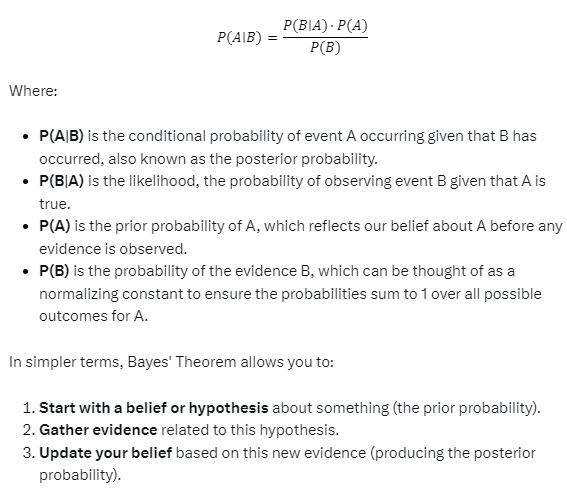
Are you curious about how we make predictions with limited knowledge? Enter Bayes’ Theorem, a cornerstone of modern statistical analysis that might just change how you view the world!
The Power of Predictions with Bayes’ Theorem
Everything in life has an element of predictability, thanks to Bayes’ Theorem. This mathematical formula isn’t just for statisticians or scientists; it influences various aspects of daily life:
Weather Forecasting 🌧️☀️: Will it rain tomorrow? Bayes helps meteorologists refine predictions by updating the probability for rain as new data comes in.
Stock Market Movements 📈📉: Investors use Bayesian statistics to adjust their portfolios, predicting market trends based on new information and past performance.
Sports Outcomes 🏆🏈🏀: Think your team will win the next game? Bayes’ theorem can provide odds by considering player stats, historical data, and current conditions.
Why Bayes’ Theorem Matters
Life isn’t like chess, where all pieces and moves are visible; it’s more akin to poker, where you play with the cards you’re dealt and the information you infer. Here’s where Bayes shines:
Acknowledging Uncertainty: We never have all the information, but Bayes allows us to update our beliefs with new evidence. It’s about making the best decision with the data at hand.
Continuous Learning: Every event provides new data, which in turn refines our predictions, making them more accurate over time.
Embracing Incomplete Information
Bayes’ Theorem teaches us that even with incomplete information, we can still navigate through life’s uncertainties effectively. It’s not about having all the answers but about improving our guesses as we learn more.
Dive Deeper with “Everything is Predictable”
For those intrigued by how mathematics shapes our ability to predict and decide, Tom Chivers’ book “Everything is Predictable” is a must-read. It explores how Bayes’ theorem is not just a formula, but a way of thinking that can be applied far beyond the realms of academia. FYI: I complete the reading yet!!
By embracing Bayes’ Theorem, we’re not just predicting the future; we’re learning how to live with uncertainty in the most informed way possible. Let’s keep the conversation going on how numbers shape our world!
Legal Disclaimer
This document was created with the assistance of artificial intelligence (AI). The information provided herein is intended for general informational purposes only and should not be considered as:
- Professional Advice: The content does not constitute legal, financial, investment, or any other form of professional advice. Always consult with a qualified professional for specific advice tailored to your situation.
- Completeness or Accuracy: While efforts have been made to ensure the accuracy of the information at the time of creation, AI-generated content may not always reflect the most current developments or nuances in human understanding. Neither the AI nor its creators can be held responsible for errors, omissions, or for outcomes resulting from the use of this information.
- Endorsement: Mention of any products, services, or entities does not constitute an endorsement or recommendation by the AI or its creators.
- Liability: Use of this document is at your own risk. The creators of the AI and any involved parties disclaim any liability for losses or damages in connection with the use of this information.
- Changes: The capabilities and understanding of AI can evolve; thus, the approach to or interpretation of the topics discussed might change over time.
- Intellectual Property: The AI-generated content may not be used for commercial purposes without further agreement. All intellectual property rights in the AI-generated material belong to their respective owners.
- Compliance with Laws: Users are responsible for ensuring compliance with all applicable laws and regulations regarding the use of AI-generated content in their jurisdiction.
Please verify all information independently before making decisions based on this document. By using this information, you agree to this disclaimer’s terms.