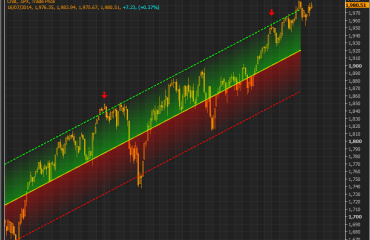
Yesterday, the Tail Risk Strategy flashed its first “Long Volatility” signal of the year, and today, the confirmation followed suit.
On the other hand, the Nasdaq is outperforming the S&P 500 today, which hasn’t happened in a while. Taking note.

Context: It Could Go Either Way
Now, for all I know, the market might stage a recovery here, and these signals could lose money, it is hard to make money with both, systematically long volatility and market timing it. That happens sometimes —it’s too early to celebrate. But here’s the thing: over the past 13 years since trading for others, a big chunk of negative performance has come from not dodging the worst of the 4 major crashes we’ve seen. Sidestepping those drawdowns is always worth a little whipsaw. If this dip deepens—say, from the current -9% in the S&P 500 to something closer to -20%—I’ll feel pretty good about taking trades with negative expectancy. The reason is the following:
The Emotional Edge of Stability
Investors are teetering on the edge of panic, I got a few calls yesterday and today. Yes, reducing drawdowns has clear financial perks. Staying calm during a crisis sets me up to make smarter trades. Preserving my “emotional capital” is an underrated advantage.
Long Volatility: High Risk, High Reward
Let’s be clear: Long Volatility positions are not safety plays. They’re bets with two typical outcomes:
- Most often, some positive news sparks a market bounce, and VIXM drops.
- Occasionally, the crash intensifies, and VIXM delivers serious profits.
The trade-off? You have to stomach some whipsaw when you’re wrong to score big when you’re right. It’s a notoriously tricky position this is why it is only with partial capital. One of the underlines of the multi-strategy fund has that tail risk approach. This is why I’m committed to taking and reporting when the signals align.
Lessons from 2008: A Tactical Backtest
Some of you know that during the last financial crisis I was part of a prop team managing 3bn in Madrid and there were great learnings. Not each crash is unique but sooner or later it will happen. It could be better, it could be worse. Will the next crash play out exactly like 1987, 2000, 2008 or 2021? No pure sure no.
The data from those years shows why I’ve decided to always tails risk hedge.
With the last closing price of the SP500, I registered -4.5% YTD (The following link will update daily during the night https://bit.ly/SPXChart) and QQQ is about -7.1% as of now.
Current levels is where relief rallies often kick in. If that happens now, I won’t be shocked.

I don’t believe we’re facing the major market crash at this moment. European equities remain resilient, suggesting stability for now. However, a significant recession is likely inevitable, and my strategy is not merely to endure it, but to position myself for success. Unlike the CEO of Berkshire Hathaway, I find little appeal in navigating such a downturn heavily invested in stocks. On the other hand, we know how extensive they use derivatives. (More info here https://finance.yahoo.com/news/look-back-warren-buffetts-37-172546595.html)
This chart shows how European Equities are holding.
Closing Thought
As of yesterday’s close (not counting today’s gains), we’re positioned for what’s ahead. Of course, the portfolios will enjoy a stronger rest of the month.
“Subscribe to my blog and social media.” Thanks for your comments and support!