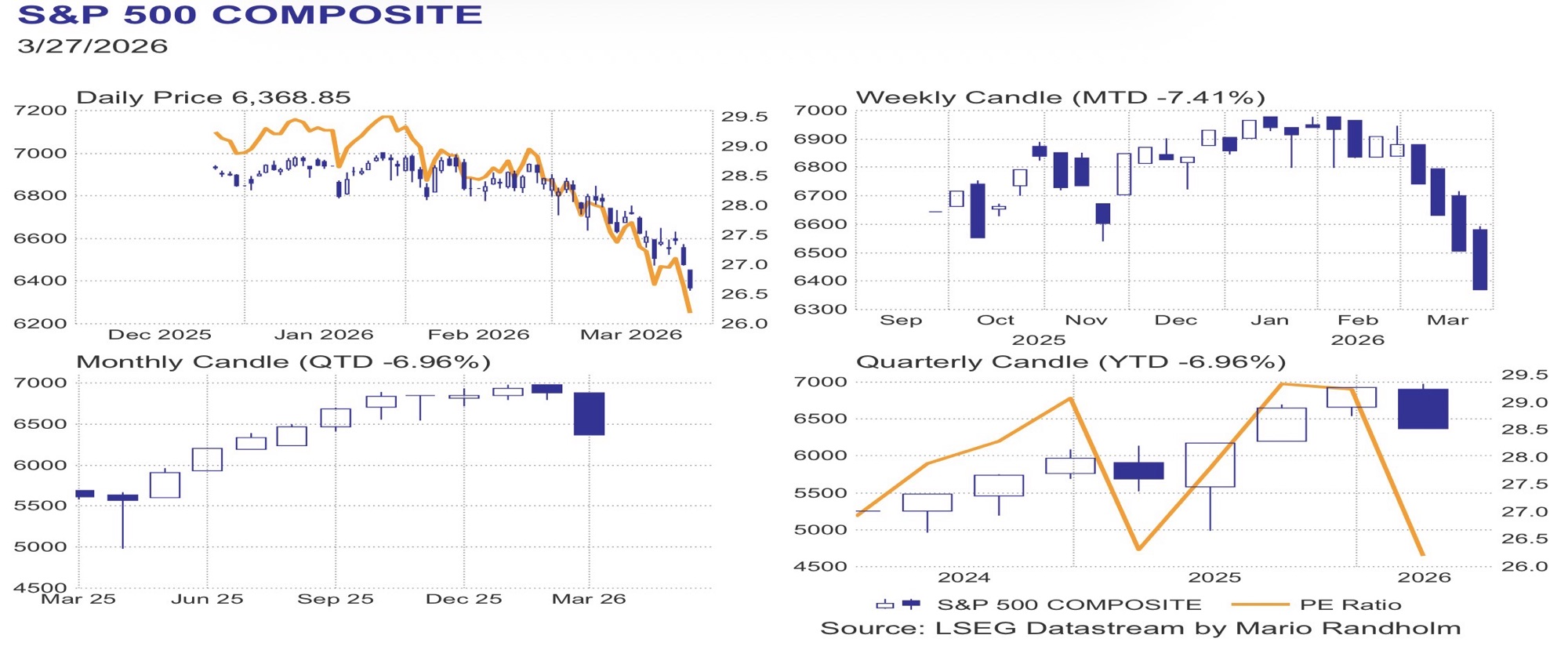
The Fall in March 2026
We’ve been saying and reading for a while: the equity market is expensive. Valuation-wise, it has been stretched for years. Most money managers don’t have the luxury of going short when things look frothy — and those who tried have been punished for over 15 years. You take a sensible short position with a yearly outlook, and a few weeks or months later the market is back to making new highs as if nothing happened.
When I talk to partners, I’m blunt: the easiest way to make money amid relatively contained volatility over the last 15 years and maybe until now has been simple — buy the dip in the S&P 500 and Nasdaq, or better yet, sell volatility and collect the premium. But past performance is not a guarantee of future results. Financial professionals are forced to write that disclaimer in every public note (and often in private ones too), not because we enjoy legalese, but because markets have a way of humbling those who forget it.
The real question now is: is the market hunting for a catalyst, or is it simply reacting to the shifting risk/reward setup of each individual wheel in the machinery?
Take oil, for example. It spiked hard — from around $60 to over $100 — driven by clear geopolitical supply disruptions. I won’t dive into the specifics here, but the move was understandable given the headlines we’ve all been reading daily. Yet even with ultra-high valuations across many stocks, we’ve now seen nearly three weeks of broad weakness. Trader may no longer chase every tweet or headline expecting the bottom to be right here.
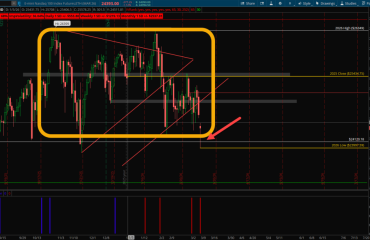
Market participants have positioned defensively. We’re flirting with a 10% correction in the S&P 500. Technically, we’re near support levels — give or take 2-3% either way — but we remain in a zone of fragility. Why? Because the downside looks materially scarier than the upside right now.
On the upside, gains may feel capped or “all priced in” after years of relentless multiple expansion, until the theme changes. On the downside, there’s easily 15% or more of air to the next meaningful support zone. That asymmetry matters. It’s the kind of setup where even a calm voice in your head (or the classic “talk to yourself like you’d talk to a child”) reminds you to respect the path of least resistance.
Two Key Pieces of Information We’re Still Watching
We have two important data points that haven’t fully played out or been confirmed in their implications.
First, the Federal Reserve Chair has signaled a reactive, not proactive, stance. They will analyze the data week by week, measure the evolving outlook, and provide measured support only if needed — particularly around inflation. Historically, inflation periods have not been kind to investors in the short term. Over longer horizons, however, inflation can support nominal asset prices, especially financial assets. But it also breeds volatility, and when combined with macroeconomic uncertainty and questions around stability, it can lay the groundwork for significant moves — in either direction.
The second critical piece is the U.S. unemployment rate. Recent readings have ticked up modestly (around 4.4% as of early 2026 data), and the labor market remains a key variable the Fed is watching closely. Any further softening could shift the balance of risks and force a more accommodative response. Conversely, if it stays resilient amid higher energy costs and other pressures, the Fed’s data-dependent patience may be tested. And we all understand controversy that the future Fed President will bring.
Bottom Line for Serious Capital
This is not the environment for heroics or forcing positions. The market has been extraordinarily forgiving of high valuations for a long time, rewarding those who stayed long and punished those who fought the trend. But trees don’t grow to the sky, and risk/reward setups do shift.
We’re in a period where outside risks appear heavier than the potential reward on the upside. Support levels are nearby, but the open downside to the next major shelf is uncomfortably wide. Combine that with a reactive Fed, lingering inflation pressures from energy shocks, housing in the US and an employment picture that hasn’t yet deteriorated sharply but bears watching.
Discipline now means respecting the asymmetry. It means not anchoring too heavily to the “buy the dip” playbook that worked so well. And above all, it means remembering that while history rhymes, it rarely repeats exactly — especially when valuations are this elevated and external shocks are in play.
Stay sharp. The next few weeks and months will tell us whether this is merely a healthy digestion of gains or the start of something more meaningful. And always this is what matters the most.
What are your thoughts on the current risk/reward? Have you adjusted positioning, or are you waiting for clearer confirmation from the labor data or Fed actions? I’d be interested to hear how other serious allocators are navigating this.
Let’s move straight to the next relevant point, which is allocation. How is your capital positioned right now? Are you still heavily concentrated in bonds and stocks?
This month has been tough for many managers. If you’re simply “playing” bonds and stocks, both have traded lower: and the same goes for most metals across the board.
The only place that has offered any real shelter in this window has been oil. But here’s the practical question: how much allocation can we honestly commit to oil? I would like to be confident that the era of $100–120–150 per barrel may be behind us. The world run better with something closer to sub-$80, even around $60.
So we circle back to the core allocation question. Yes, we can play local and international equities. Yes, we can play local and international bonds. Commodities have their place, but their weighting is naturally limited. That reality opens the door to alternatives — and here I draw a clear line.
I am a firm believer that private equity carries outsized risk, especially in the current environment. I have been telling my partners for several years now: stay away, particularly if you are over 50/55 years old. Ten and five years ago it was extremely popular; I never understood the enthusiasm. The financing of projects should not have been past to high net worth individuals not even to ultra and most “sofisticados” ones.
That leaves us with true alternatives. Broadly speaking, they come in two camps:
- Those that perform when markets rise (often equity-like or high-beta strategies).
- Those that do not chase the upside but are managed to deliver in range-bound or falling markets — and crucially, those that actually profit when the broader market drops.
It is the second group I want to focus on. Do you have them in your portfolio?
They do not need to be large: 7 % to 15 % is usually enough. In periods of turbulence, that pocket can materially optimise your overall return. Yet patience is mandatory in this business. Over the past 10–15 years some of these strategies have shined others have been punished and have underperformed.
It is not yet clear they will shine in the next decade it will never be. I trust the math, when you run the numbers and stress-test a properly diversified book, there is clear room for these managers: not just for diversification, but for genuine asset preservation and, in the right conditions, meaningful appreciation.
The good news? There are many such options today: daily-liquid, monthly-liquid, and quarterly-liquid vehicles which can sit comfortably alongside (or even carry material weight relative to) your core bonds-and-stocks allocation.
So I turn the question to you, genuinely:
How are you positioned today? Do you already have that defensive sleeve, or are you still 100 % in traditional assets? What has worked (or hurt) in your book?
Let’s talk — real numbers, real portfolios, no fluff. I’m listening.
Best Regards,
Mario