Last night I took some time to read key X users’ profiles and what and how they are posting and this morning I reviewed a few short notes from Plato’s Republic, The Perfect Society. I am still digesting both blocks of information and in a pursue of a clear thought for todays market I began this writing.
Socratic Method: Socrates introduced a form of dialogue that encourages critical thinking and the questioning of assumptions. This method remains a cornerstone of intellectual inquiry and education.
Plato’s Allegory of the Cave: This powerful metaphor illustrates the nature of reality and human perception. It suggests that most people live in a world of shadows, unaware of the true nature of things, and that education can lead to enlightenment.
Aristotelian Ethics: Aristotle’s concept of virtue ethics, which focuses on cultivating moral character rather than following rigid rules, continues to influence modern ethical discussions.
A notable transformation is occurring in information consumption patterns:
Investment professionals (like me) are dividing their attention between instant updates and in-depth analysis
Social media platforms now compete with traditional news outlets for attention and key data (the tariff halts was on X before at Refinitive with Reuters -Pro News and Terminal)
Real-time updates are replacing methodically researched articles — too much info for a human to quickly process
Political polarization is increasingly and a simple AI model can determine if you consume right or left articles….
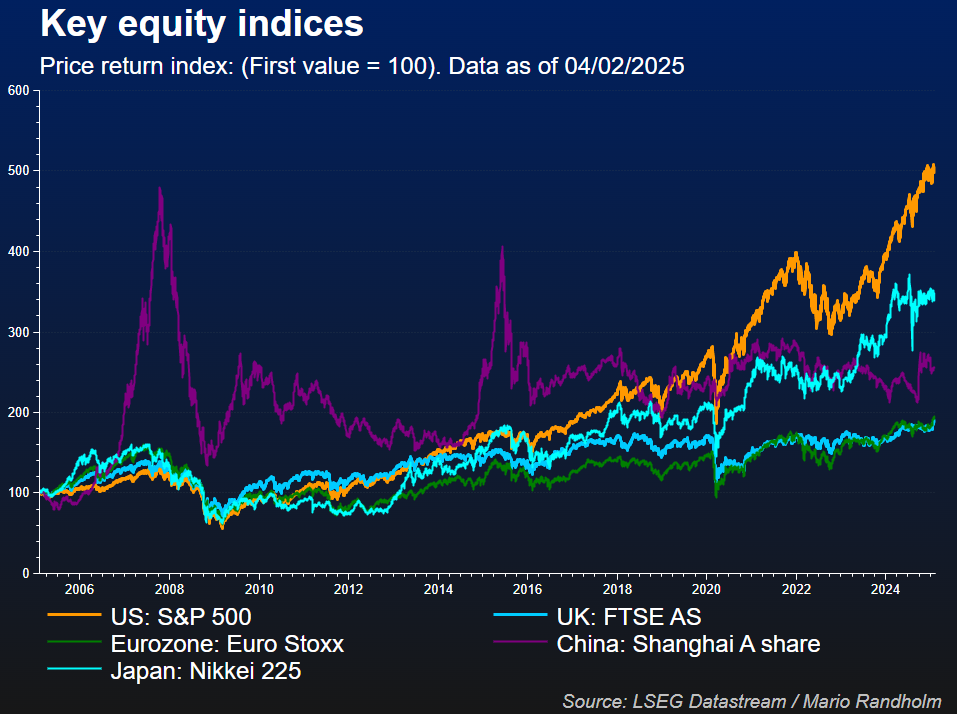
Let’s focus on the market data. The chart below indicates that the Eurozone’s stock performance is leading, followed by the US, with the UK coming in third. Nov 4th to today.

With the help of AI, I have pasted and proofread the comments below, some of which I consider simplistic but consider important to keep and store. Grok and Perplexity were used to review the post above.
US: S&P 500 – The S&P 500 has demonstrated remarkable resilience and growth, maintaining a consistent upward trajectory with minor fluctuations. This index has remained above the baseline, suggesting a robust economic environment in the US, buoyed by technological advancements, consumer confidence, and favorable monetary policies. Given the stability and growth, this might be an opportune time to consider investments or expansions within the tech sector, as highlighted by recent trends in CEO priorities towards digital transformation and AI integration.
Eurozone: Euro Stoxx – The Euro Stoxx index shows a pattern of volatility but with an overall upward trend. Despite geopolitical tensions and economic uncertainties in Europe, the index has managed to stay above the initial value, reflecting the region’s adaptability and the strategic focus on energy transition and digital innovation. For CEOs with European interests, focusing on sustainability and digital transformation could align well with market trends, enhancing long-term value.
Japan: Nikkei 225 – The Nikkei has experienced significant volatility, yet it has maintained a positive return overall. Japan’s market is influenced by both domestic policies aimed at economic revitalization and external trade dynamics. Given this, CEOs might find opportunities in sectors like robotics, automotive, and electronics, where Japan continues to lead, especially with the integration of AI for operational efficiency.
UK: FTSE AS – The FTSE AS has shown a mixed performance with periods of decline, yet it has rebounded effectively. The UK market’s performance is reflective of Brexit aftermath stabilization efforts, global trade relations, and energy sector dynamics. For those with investments or operations in the UK, focusing on sectors like renewable energy or financial services could be strategic, considering the UK’s push towards net-zero emissions and financial innovation.
China: Shanghai A Share – Perhaps the most dramatic of all, the Shanghai A Share index has seen considerable swings, with a notable dip towards the end of 2024. This volatility underscores the complex interplay of regulatory changes, real estate market dynamics, and international trade relations in China. However, the recent recovery suggests a potential stabilization. CEOs might consider cautious engagement with China, focusing on technology, consumer goods, and green energy, aligning with global trends and China’s policy directions.
The correlation between the four first index is crucial, China class A starting falling the last days of 2024 and did not recover. Euro Stoxx will benefit from a weaker EUR and potential volatility in the US.
Same Chart for the last 20 years:

Expanding or going back to the new narrative for a few days ago,
I have been writing that the new narrative is imposing. This is neither inherently good nor bad as it currently stands. I’ve tried to maintain the most apolitical stance possible. A good example can be seen in premium subscriptions to publications where I dedicate time such as, but not limited to The Economist, FT.com, Reuters, and Bloomberg, should be simply reporting on the change rather than influencing it. The key here is to understand if the writer jobs are editorializing or reporting.
I’ve noticed a shift, personally, in how news is being consumed. When I talk to investors, I see that they are not disagreeing with this change. Reading news on social media platforms or key profiles, which are often very political, versus editorial reading, which take days to produce a well-researched piece of informative content, is making a significant difference in how we form opinions and develop the thesis needed to reach conclusions.
On the other hand, I like to believe that the S&P 500 reflects market participants’ reality and financial opinions through its price and return, acting as an indicator of economic health and investor sentiment. It responds to economic data, corporate earnings, global events, policy changes, and sectoral trends, encapsulating both rational analysis and behavioral finance. This index provides a real-time consensus on market conditions, influenced by both tangible economic factors and the collective mood of investors.
“Subscribe to my blog and social media, just in case accounts becomes inaccessible.”
Disclaimer:
Article on X