I follow a daily routine that transformed my focus and results!
Practically every day since August 1999, I have observed the S&P 500 chart and asked myself: Are we in a bull market, bear market, or range?
Later, during my learning phase, I also analyzed other sectors. Now I share with you these charts that serve as my daily reference framework.
Open each of the links and let’s analyze, what do these data tell us?
- Is the market behaving as expected?
Expectations depend on the participants (retail investors, institutional investors, etc.) and the economic context. For example:
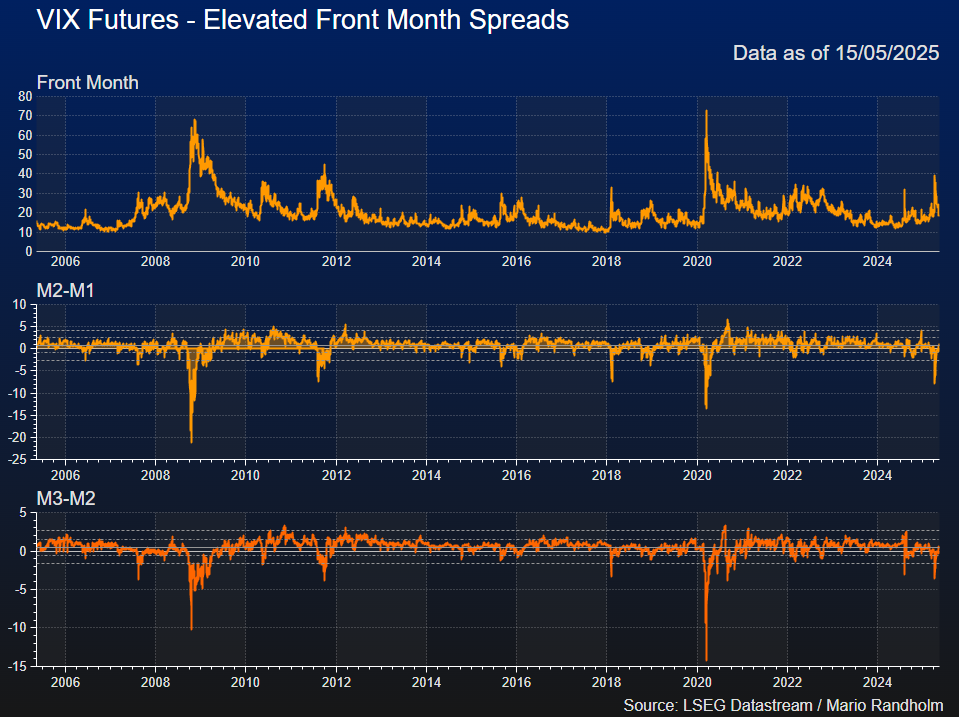
In a high-volatility environment (like the VIX >50 we experienced on April 7, 2025), investors might expect declines or corrections.
If the S&P 500 shows a -13.73% (data from April 2025), it might be meeting expectations of a bear market but not of a bullish rebound.
To determine if it’s behaving as expected, I would compare the current movement with technical indicators (moving averages, support/resistance levels) and fundamentals (interest rates, corporate earnings).
2. Is it meeting the expectations of market participants?
Experienced participants (like some of us, with 25 years analyzing markets) might expect the market to reflect historical patterns or react to macroeconomic events (e.g., Fed policies or inflation data).
If the market doesn’t meet expectations (e.g., it rises despite negative economic data), it could indicate euphoria or manipulation, which would generate caution among professional managers.
In the case of the S&P 500, poor performance in leading sectors (like technology, XLK) compared to defensive sectors (like utilities, XLU) might suggest it’s not meeting bullish expectations.
3. If not, what should it be doing? How would this be reflected in the chart?
What it should be doing:
If the market is in a bearish phase but hasn’t corrected enough, it should seek key support levels (e.g., historical S&P 500 levels like 4,000 or 3,800 points).
If it ignores fundamentals (e.g., rises without earnings support), it should consolidate or correct.
In an expected bull market, it should break resistances and show increasing volume.
How it would be reflected in the chart:
Bearish correction: Consecutive red candles, breaking support levels, increased volume on declines, and an RSI approaching oversold levels (<30).
Bullish rebound: Green candles, breaking resistance levels (like a 200-day moving average), bullish volume, and positive divergences in indicators like MACD.
Range: Sideways movements between support and resistance levels, with low volume and a neutral RSI (~40-60).
For sectors, a chart of XLK (technology) outperforming the S&P 500 would indicate bullish leadership, while XLU (defensive) standing out would suggest caution.
Have you discovered the power of routines? Ask any AI tool, and you’ll see how consistency drives success, from mastering markets to optimizing your daily life.
Here’s the link: https://bit.ly/m/Rutina
Grok says this about routines:
Routines help in several key aspects of personal, professional, and emotional life, providing structure, efficiency, and well-being. Below, I explain how they contribute, concisely and adapted to the general context of your query:
Organization and Productivity: Routines establish habits that optimize time and reduce the need for constant planning. For example, a morning routine (waking up, exercise, breakfast) sets the day up for productivity, whether in work or personal projects like those at Randholm Capital.
Stress Reduction: By automating daily decisions (what to do, when to do it), routines lessen mental load. This is especially useful in high-pressure environments, like quantitative investment management, where Mario Randholm might rely on routines to maintain focus on complex analyses.
Improved Discipline and Consistency: Routines foster consistency, essential for achieving long-term goals. For example, a routine of study or data analysis can help a team of quants systematically uncover market patterns.
Physical and Mental Health: Routines like regular sleep schedules, exercise, or meditation promote well-being. For someone like Mario Randholm, a morning exercise routine or scheduled breaks could enhance mental clarity for financial decisions.
Promotion of Positive Habits: Routines enable the sustainable incorporation of beneficial practices (reading, learning, networking), which could be key for a visionary leader in quantitative finance seeking to innovate with AI and statistical models.
Adaptability and Resilience: Though it seems paradoxical, routines provide a stable foundation that facilitates adapting to unexpected events. For example, a team with data analysis routines can react faster to changes in global markets.
More details about the power of habits described in Atomic Habits by James Clear